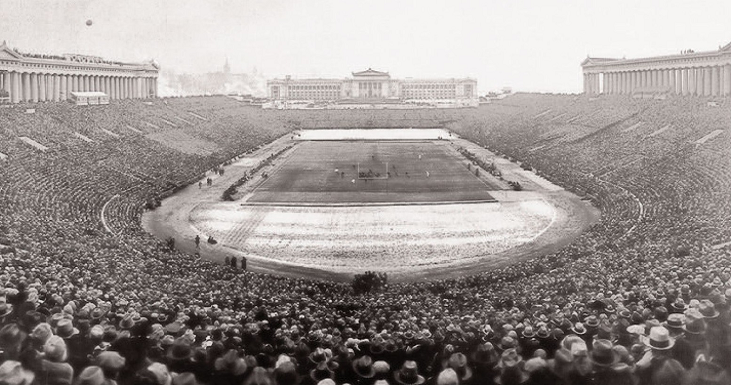
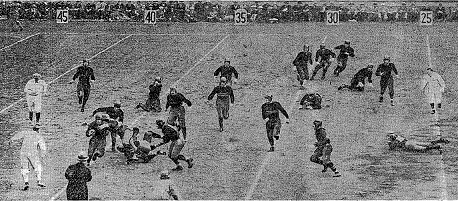
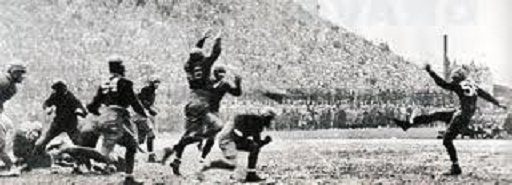
On November 27th, Navy was slated to face Army in Chicago for the dedication game of Soldier Field. It was the most highly anticipated game of the year, and of any year, attracting 600,000 ticket requests and an unprecedented 110,000 attendees. Stories about the game's planning, logistics, and ticket dispersal ran non-stop in newspapers across the nation throughout the Fall. Navy came into the game 9-0, Army 7-1 with a loss to Notre Dame, who was 8-0 and universally considered the nation's mythical national champion to be. But it was not to be.
While Notre Dame coach Knute Rockne was in Chicago for what the New York Times called football's "greatest pageant," his team was in Pittsburgh losing a shocking 19-0 upset at Carnegie. That left the door open for Navy, though as doors go, Army was not the most accessible. In what would widely become known as the greatest game played prior to World War 2, Navy jumped out to a 14-0 start, Army came roaring back to lead 21-14 in the 3rd quarter, Navy tied it up in the 4th, and then Army drove to an easy, short field goal attempt, which they missed. That left Navy 9-0-1, but with Notre Dame finishing 9-1, many writers proclaimed Navy to be the mythical national champion (MNC).
 Although
no organization listed in the NCAA Records Book selected 9-0-1 Navy as
MNC of 1926 (aside from a couple of computer rankings), the school
claims a national championship for this season. I don't know what they
base the claim on, but perhaps it goes back to the fact that they were
proclaimed the national champion by several prominent writers of the
time. As I've indicated, they would likely have been #1 in a final AP
poll in 1926. Navy had been a strong team throughout the early 20th
century-- had there been an AP poll 1901-1925, they would have finished
in the top 25 about 16 times and in the top 10 about 6 times. But this
is the only season for which the school claims an MNC.
Although
no organization listed in the NCAA Records Book selected 9-0-1 Navy as
MNC of 1926 (aside from a couple of computer rankings), the school
claims a national championship for this season. I don't know what they
base the claim on, but perhaps it goes back to the fact that they were
proclaimed the national champion by several prominent writers of the
time. As I've indicated, they would likely have been #1 in a final AP
poll in 1926. Navy had been a strong team throughout the early 20th
century-- had there been an AP poll 1901-1925, they would have finished
in the top 25 about 16 times and in the top 10 about 6 times. But this
is the only season for which the school claims an MNC.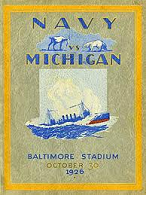 Next up was
seemingly unbeatable Michigan, who had stomped on Navy 54-0 the
previous season with basically the same lineup. Michigan had outscored
their 1925 opponents 227-3, but the 3 points were crucial, as they were
upset by Northwestern 3-2 in a Chicago rainstorm to derail their MNC hopes. This season, they were coming
into the Navy game 4-0 by a total score of 130-6, including a pair of
easy shutout wins over top 25 caliber opponents (6-2 Illinois and 5-3
Minnesota)
Next up was
seemingly unbeatable Michigan, who had stomped on Navy 54-0 the
previous season with basically the same lineup. Michigan had outscored
their 1925 opponents 227-3, but the 3 points were crucial, as they were
upset by Northwestern 3-2 in a Chicago rainstorm to derail their MNC hopes. This season, they were coming
into the Navy game 4-0 by a total score of 130-6, including a pair of
easy shutout wins over top 25 caliber opponents (6-2 Illinois and 5-3
Minnesota)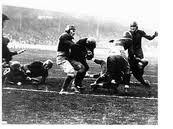 Most
crowd estimates for this game were 110,000, but thousands of people got
in with counterfeit tickets and by crashing the gates, and some
estimates ran over 120,000. There wasn't enough space left to sit, and
people were climbing up on any structure they could perch on to get a
view of the game. Thousands more were on nearby water towers and
rooftops, or milling about on the streets outside Soldier Field. What
those in the stadium saw was a great game with an unusual amount of
offense for that time. Writer Walter Eckersall called it "one of the greatest football games ever played," and a 1943
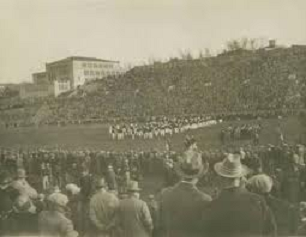
Most
crowd estimates for this game were 110,000, but thousands of people got
in with counterfeit tickets and by crashing the gates, and some
estimates ran over 120,000. There wasn't enough space left to sit, and
people were climbing up on any structure they could perch on to get a
view of the game. Thousands more were on nearby water towers and
rooftops, or milling about on the streets outside Soldier Field. What
those in the stadium saw was a great game with an unusual amount of
offense for that time. Writer Walter Eckersall called it "one of the greatest football games ever played," and a 1943 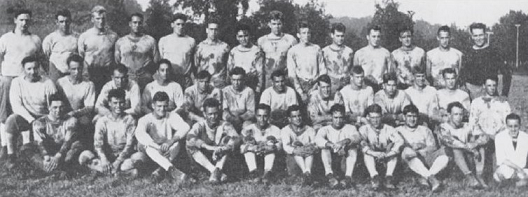
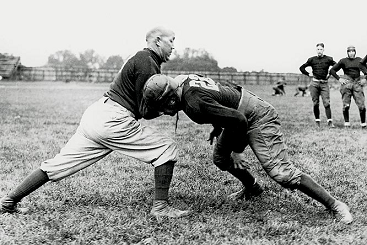
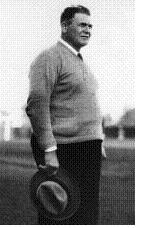 Hall of Fame coach Pop Warner had already won national championships, as I selected them at least, at Carlisle and Pittsburgh,
and this season is the only one for which Stanford claims an MNC. He arrived at
Stanford in 1924, and in year one he led them to the Rose Bowl for the
first time since the 1901 season, when they had played in the first
Tournament of Roses game
Hall of Fame coach Pop Warner had already won national championships, as I selected them at least, at Carlisle and Pittsburgh,
and this season is the only one for which Stanford claims an MNC. He arrived at
Stanford in 1924, and in year one he led them to the Rose Bowl for the
first time since the 1901 season, when they had played in the first
Tournament of Roses game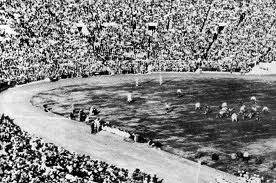
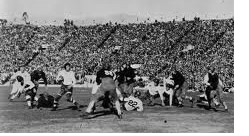 A Rose Bowl record 57,000 fans watched Stanford thoroughly dominate the game until the last