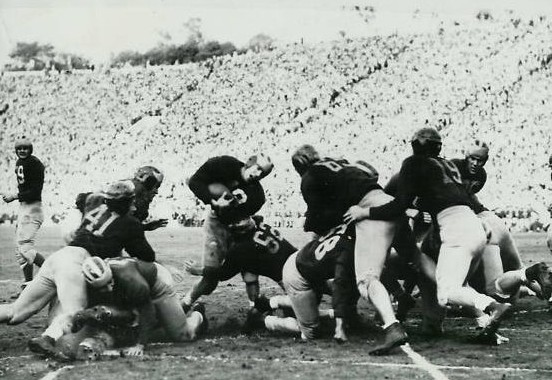

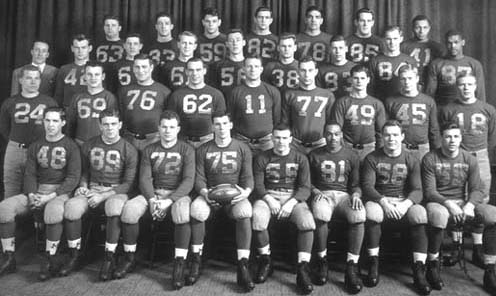
| Michigan State (7-2) | 55-0 | #25 |
| Stanford (0-9) | 49-13 | |
| Pittsburgh (1-8) | 69-0 | |
| at Northwestern (3-6) | 49-21 | |
| Minnesota (6-3) | 13-6 | (#27-33) |
| at Illinois (5-3-1) | 14-7 | (#26-32) |
| Indiana (5-3-1) | 35-0 | (#29-36) |
| at Wisconsin (5-3-1) | 40-6 | (#28-34) |
| Ohio State (2-6-1) | 21-0 | |
| Rose Bowl Southern Cal (7-2-1) | 49-0 | #7 |
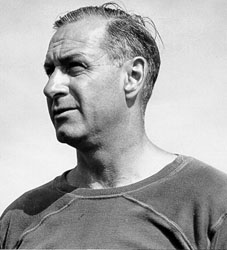 Michigan
was the most consistently powerful football program from 1901 to this
point in history, and they had previously contended for mythical
national championships in 1901, 1902, 1903, 1904, 1918, 1922, 1923, 1925,
1932, and 1933.
The school claims MNCs for all but 2 of those years, though I only
selected them as national co-champions for 4 of them (1902, 1918, 1932,
and 1933), and if there had been an AP poll all of those years, they
would have likely ended up #1 just once, in 1933. And of course they
didn't end up #1 this year either, at least not in the "official" AP
poll.
Michigan
was the most consistently powerful football program from 1901 to this
point in history, and they had previously contended for mythical
national championships in 1901, 1902, 1903, 1904, 1918, 1922, 1923, 1925,
1932, and 1933.
The school claims MNCs for all but 2 of those years, though I only
selected them as national co-champions for 4 of them (1902, 1918, 1932,
and 1933), and if there had been an AP poll all of those years, they
would have likely ended up #1 just once, in 1933. And of course they
didn't end up #1 this year either, at least not in the "official" AP
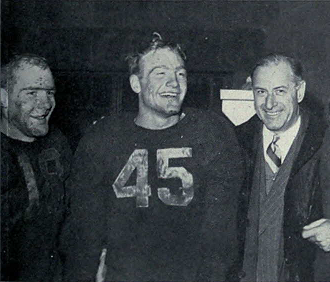
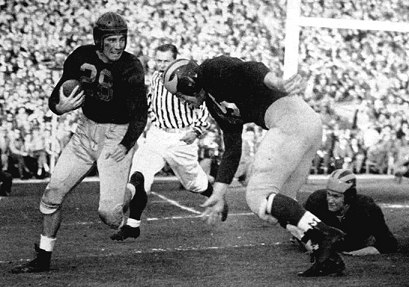
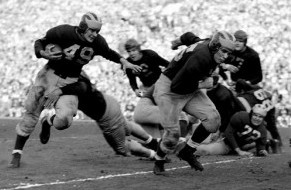
poll.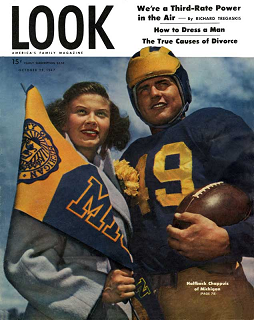 Michigan's
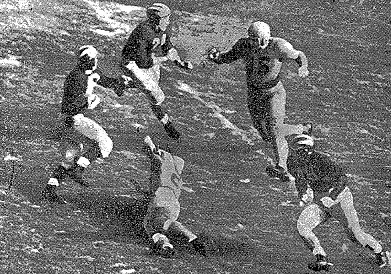
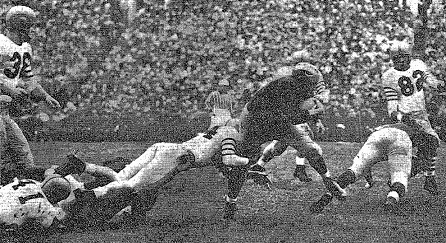
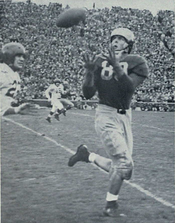
star player was Hall of Famer Bob Chappuis (pictured on the cover of Look magazine). He was a passing
specialist, but Michigan was still using the single wing offense rather
than the spreading T-formation, so Chappuis was a halfback. He was a
unanimous All American this season, and finished 2nd in the Heisman
race to Notre Dame quarterback Johnny Lujack, much as his team finished
#2 to Notre Dame in the AP poll (the "official" one anyway). Chappuis
broke the Big 10 (actually Big 9 at this time) record for total offense
in 1946, then broke it again this season. In 1946 he passed for 734
yards and rushed for 501, and this season he passed for 976 (11
touchdowns) and rushed for 544 (5 touchdowns). He was the MVP of the
Rose Bowl to cap his career, rushing 13 times for 91 yards and hitting
14 of 24 passes for 188 yards.
Michigan's
star player was Hall of Famer Bob Chappuis (pictured on the cover of Look magazine). He was a passing
specialist, but Michigan was still using the single wing offense rather
than the spreading T-formation, so Chappuis was a halfback. He was a
unanimous All American this season, and finished 2nd in the Heisman
race to Notre Dame quarterback Johnny Lujack, much as his team finished
#2 to Notre Dame in the AP poll (the "official" one anyway). Chappuis
broke the Big 10 (actually Big 9 at this time) record for total offense
in 1946, then broke it again this season. In 1946 he passed for 734
yards and rushed for 501, and this season he passed for 976 (11
touchdowns) and rushed for 544 (5 touchdowns). He was the MVP of the
Rose Bowl to cap his career, rushing 13 times for 91 yards and hitting
14 of 24 passes for 188 yards.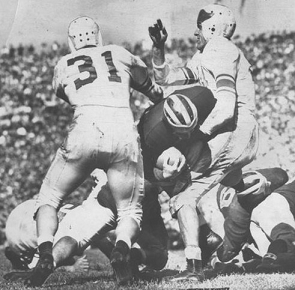
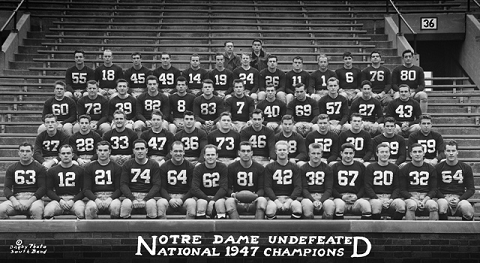
| at Pittsburgh (1-8) | 40-6 | |
| at Purdue (5-4) | 22-7 | (#30-37) |
| Nebraska (2-7) | 31-0 | |
| Iowa (3-5-1) | 21-0 | |
| (Cleveland) Navy (1-7-1) | 27-0 | |
| Army (5-2-2) | 27-7 | #12 |
| at Northwestern (3-6) | 26-19 | |
| Tulane (2-5-2) | 59-6 | |
| at Southern Cal (7-2-1) | 38-7 | #7 |
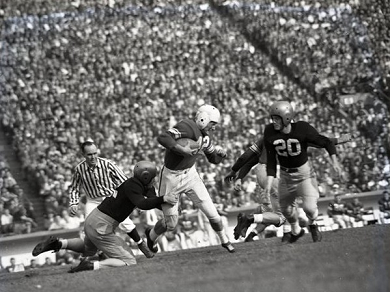
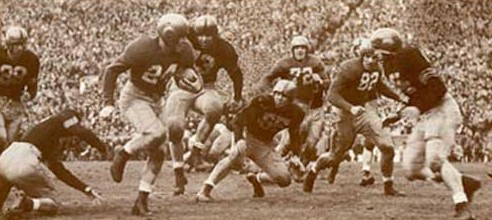
| Texas Tech (6-5) | 33-0 | |
| at Oregon (7-3) | 38-13 | |
| North Carolina (8-2) | 34-0 | #8 |
| (Dallas) Oklahoma (7-2-1) | 34-14 | #20 |
| (Memphis) Arkansas (6-4-1) | 21-6 | #15 |
| Rice (6-3-1) | 12-0 | #10 |
| at Southern Methodist (9-0-2) | 13-14 | #3 |
| Baylor (5-5) | 28-7 | |
| Texas Christian (4-5-2) | 20-0 | #19 |
| at Texas A&M (3-6-1) | 32-13 | |
| Sugar Bowl Alabama (8-3) | 27-7 | #11 |
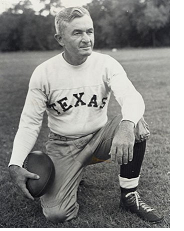 Although Texas had been fielding strong, winning football teams in
their region from the start (4-0 in their initial campaign in 1893),
and they were the strongest football school in the Southwest for the
1893-1939 period, they had had little national success and enjoyed
little national prominence until the 1940s. SMU, TCU, and Texas A&M
were more prominent because of big nationally relevant wins in the
previous 2 decades, and all 3 had been named a national champion by one
contemporaneous source or another in the 1930s. Texas nevertheless had
a winning all-time record against all of them heading into this 1947
campaign.
Although Texas had been fielding strong, winning football teams in
their region from the start (4-0 in their initial campaign in 1893),
and they were the strongest football school in the Southwest for the
1893-1939 period, they had had little national success and enjoyed
little national prominence until the 1940s. SMU, TCU, and Texas A&M
were more prominent because of big nationally relevant wins in the
previous 2 decades, and all 3 had been named a national champion by one
contemporaneous source or another in the 1930s. Texas nevertheless had
a winning all-time record against all of them heading into this 1947
campaign.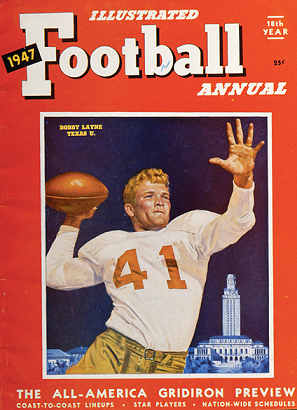
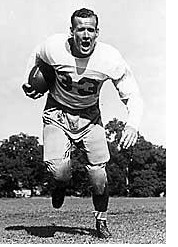 Notre Dame's Johnny Lujack and Michigan's Bob Chappuis
were the nation's most heralded players this season, but Texas' star player has
surpassed both in fame with the passage of time. That would be
consensus All American quarterback Bobby Layne (pictured above on the cover of the 1947 Illustrated Football Annual), who is enshrined in
both the college and pro Halls of Fame. Layne was all-SWC 4 straight
years at Texas 1944-1947. In a 40-27 win over Missouri in the 1946
Cotton Bowl, Layne accounted for all 40 points, scoring 4 touchdowns,
throwing 2 touchdown passes, and kicking 4 extra points. He finished
8th in the Heisman vote in 1946, and 6th this year. He passed for a
school record 3145 yards in his career on 210 completions in 400
attempts.
Notre Dame's Johnny Lujack and Michigan's Bob Chappuis
were the nation's most heralded players this season, but Texas' star player has
surpassed both in fame with the passage of time. That would be
consensus All American quarterback Bobby Layne (pictured above on the cover of the 1947 Illustrated Football Annual), who is enshrined in
both the college and pro Halls of Fame. Layne was all-SWC 4 straight
years at Texas 1944-1947. In a 40-27 win over Missouri in the 1946
Cotton Bowl, Layne accounted for all 40 points, scoring 4 touchdowns,
throwing 2 touchdown passes, and kicking 4 extra points. He finished
8th in the Heisman vote in 1946, and 6th this year. He passed for a
school record 3145 yards in his career on 210 completions in 400
attempts.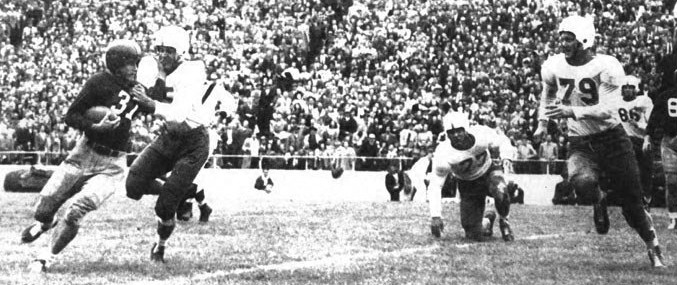
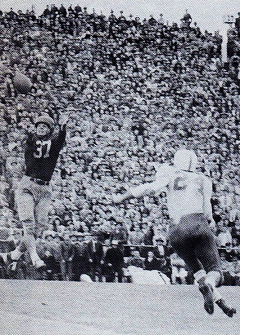
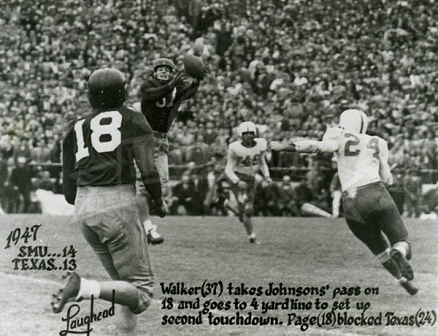
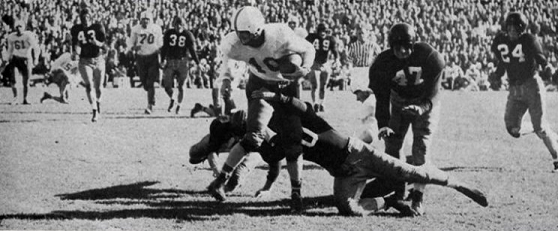
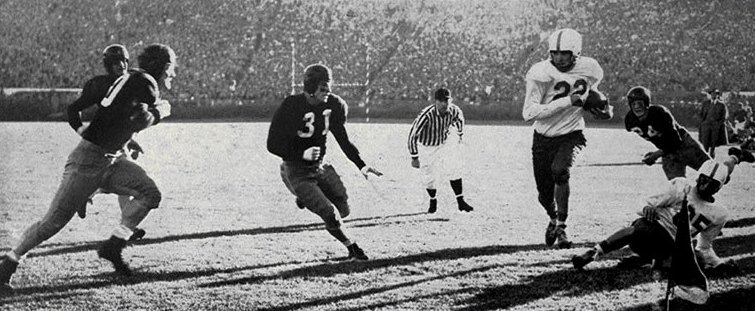
| Michigan 10-0 | Notre Dame 9-0 | Texas 10-1 | ||||||||||||||||||||||||||||||||||||||||||||||||||||||
|---|---|---|---|---|---|---|---|---|---|---|---|---|---|---|---|---|---|---|---|---|---|---|---|---|---|---|---|---|---|---|---|---|---|---|---|---|---|---|---|---|---|---|---|---|---|---|---|---|---|---|---|---|---|---|---|---|
|
|
|
||||||||||||||||||||||||||||||||||||||||||||||||||||||
| 1) Boand
(math system) |
5.0 |
| 2) AP Poll College Football Researchers Association Poling (math) |
4.93 |
| 5) DeVold (math) | 4.91 |
| 6) Billingsley (math) | 4.87 |
| 7) National Championship Foundation | 4.70 |
| 8) Litkenhous (math) | 4.64 |
| 9) Houlgate (math) | 4.45 |
| 10) Berryman (math) | 4.28 |
| 11) Dunkel (math) | 4.27 |
| 12) Sagarin (math) | 4.23 |
| 13) Helms Foundation | 4.20 |
| 14) Sagarin-ELO (math) | 4.11 |
| 15) Williamson (math) | 3.62 |
| 1) Boand (math system) | 4.26 |
| 2) College Football Researchers Association | 4.22 |
| 3) Poling (math) | 4.11 |
| 4) Helms | 4.09 |
| 5) Sagarin-ELO (math) | 4.06 |
| 6) National Championship Foundation | 3.96 |
| 7) Dickinson (math) | 3.49 |
| 8) Houlgate (math) | 3.35 |
| 9) Billingsley (math) | 3.34 |
| 10) Sagarin (math) | 3.28 |
| 11) Parke Davis | 2.77 |
| 1) Houlgate (math system) | 4.5 |
| 2) Helms | 4.3 |
| 3) Parke Davis | 4.2 |
| 4) National Championship Foundation | 3.7 |
| 5) Billingsley (math) | 3.6 |